Monday, June 23, 2014

Iva Book History

(Six years ago, my children and I went on a tour with my mother to see her childhood haunts. As we drove to and from there, she named the people who used to live in the houses surrounding the area. Back in the 30s & 40s, most people settled in one place their entire lives as did their children after them. I took these pictures that day. Here is a little about my mother, Iva Book, to go with them.)

Iva Book's childhood home  

Iva Book was the daughter of Jesse and Zola (McClure) Junk. Zola worked hard to care for her family but she was especially famous for baking bread, raising violets on her sun porch, and making beautiful quilts. Jesse, besides contracting many carpentry jobs, worked on the Tuscarora Tunnel of the turnpike. In later years, he grew hard of hearing which was blamed on the noise level when he worked in that tunnel. Back then, they didn't wear ear protectors.

Iva had two siblings, John and Glen. She and her brothers played in the woods above their house constantly. She appropriated any broken dishes for playing house in the woods. Her brother John lived most of his life at Cisney Run where his wife ran their general store and he worked other places as a carpenter. Brother Glen, also a carpenter, lived most of his life in Carlisle area.

Iva Book outside of former McCulloch Mills School     


Former McCulloch Mills Presbyterian  Church

Iva married John Sheesley in 1946. She moved into his family’s home where they all lived until a year later when his parents built a house down the road. John had been farming the farm from high school on while his dad, George Sheesley, had worked a job as an engineer on the railroad. After George and his wife, Emma, moved, John and Iva bought the farm. They had two children, Gary and Sandy (me!).

Iva kept house, cooked for the farm help, and helped some with the barn work. She loved to sew and made almost all of her family's clothes. Hanging clothes on the clothesline happened regularly even after she acquired a dryer. The couple had an orchard and a big garden. In the summer the family canned pears, peaches, cherries, and tomatoes They also froze peas, corn, and green beans.  

After John passed away, Iva married Roy Book from Port Royal. They stayed on the farm but rented it out for others to farm. Roy worked most of his life as the mill manager at Goodman’s Mill in Port Royal. He passed away in 2001.

Today, Iva Book, now 88, is still active and also loves to make quilts. She, as her mother before her, makes her quilts to give away. They each made at least one for each child and grandchild. In addition, Iva works with other ladies to make 200-300 each year for their church to give to the needy. And she still hangs her clothes outside!

Friday, June 20, 2014

Some Thoughts from a Homeschool Mother

This past May I finished 20 years which I have devoted to the education of our four children.

Here are a few of my thoughts:

Yippee! I am glad to be done!

I am so happy that I did this.

The results so far have been worth the effort. Our main purpose in homeschooling has been to produce godly offspring. All four are believers, devoted to Christ, attending church, and growing in faith. Thank you, Lord.

I wish more people would consider this option, but I understand why more don’t. You have to be willing to be a loner at times. For me, it took a lot of faith. No one else in my family had ever done this. I taught, trusting God for the results.

Here are a few scenes from over the years:

Suzanne, at about age seven, lying on the seat of the sofa with her legs up in the air against the back. Hard to describe, but what a memory! I remember being astonished at her position while I read to her, but how typical of her. She needed to move, feel things, do things. That is how she learned best.  She is now a wife to a superb carpenter and loves to garden, plan parties, and socialize with her friends. She works as a landscaper, takes photos, and travels for a textbook company as a part time buyer.

Tad, getting up each morning, parking himself on the sofa, and staying there until his school work was finished.  Tad is married, works as a mechanic in a Chevy dealership, and just bought a house.

Little Matt, at the time, (now he is six ft.) listening intently as I read to the two oldest. Later, when I asked questions, this three year old would know most of the answers! Matt is still undecided about his life work. He picks up odd jobs and leads a Bible study. His current spiritual growth is such a joy to us.

Ben—oh, Ben, my graduate. Sometimes, I thought I would go crazy with the amount of breaks from school he needed. But he has made it to graduation, and I so love the man he has become. Ben is going to work this summer at a camp. After that, he wants to try some different jobs before deciding on a life career.

How proud we are of all of them!

Now I am ready to do something else.


Homeschooling, easy? No way, but so worthwhile.


Wednesday, June 18, 2014

PA Memories by Lisa Godfrees

Lisa responded first to my request for stories about Pennsylvania, and I’m glad she did. Such a good time I have had, reading her blog and getting to know her in cyberland. Lisa’s life experiences and her direction that she has chosen fascinates me.

Briefly, she worked as a forensic scientist, gave it up to concentrate more on her family, loves to learn, loves to read, and loves to write! She is concentrating on YA Fiction and recently visited Pennsylvania for a Realm Makers conference. Here is her memory of our beautiful state:

The most beautiful place I have visited in PA is Bushkill Falls. The family and I went there two weeks ago, and it is such a wonderful place. The waterfalls are magnificent, as are all the wooden walkways that frame the falls to make them accessible to visitors. And the trees--so many different colors of green! It's one place I will visit each time I'm in the area. I will never get tired of the roar of the water in the majesty of nature!

Bushkill Falls is in Northeastern Pennsylvania east of Wilkes Barre and north of Philadelphia.


 http://lisagodfrees.com/

Lisa's books:
Mike Lynch's No Revolution is Too Big - Vol. 9 - A Sirius Revolution
Colony Zero - Vol. 1 - Contact


Monday, June 16, 2014

CCC Camps

As a child, I remember my uncle talking about the CCC Camp that had been located nearby our family’s farm in Licking Creek Valley, Juniata County, Pennsylvania. How did it come to be there? In 1933, right after he took office, President Franklin D. Roosevelt started a group of government programs to help relieve the country from the effects of the 1929 stock market crash. One of his programs was the Emergency Conservation Work renamed the Civilian Conservation Corps which was nicknamed CCC. The plan involved putting unmarried, unemployed men ages 18-25 to work on projects.

After being selected, groups of these men moved into an area and lived in tents until some permanent buildings were built. They received uniforms and three meals a day. They earned $30 a month that most sent home to their families. Pennsylvania contained 113 of these camps. 194,500 Pennsylvanians served in the Civilian Conservation Corps.
A model of a CCC Camp barracks displayed at World’s End State Park Visitors Center
The U.S. Army ran the camps but foresters, carpenters, and other crafts people directed the work. The men worked on roads, picnic areas, swimming areas, and campgrounds in state parks and other places. Supervised CCC workers constructed much of the stone work you see in Pennsylvania state parks.

The plaque on the back of the fireplace
A fireplace built at Penn Roosevelt State Park by CCC workers

When World War II started, the CCC Camps ended.

Pictures taken by author. Information gathered from the Pennsylvania Department of Conservation  and Natural Resources site:


Friday, June 13, 2014

Stephen Foster

Having the interest in Pennsylvania history that I do, I collect Pennsylvania items. Walking through a flea market one day, I came upon a song book for schools. Printed in 1947, the book, Songs of Stephen Foster  edited/arranged by Will Earhart with Edward B. Birge and published by the University of Pittsburgh attracted me because I knew Mr. Foster had been born in Pennsylvania.

When I went to elementary school we learned many of Stephan Foster’s songs: Beautiful Dreamer, Camptown Races, My Old Kentucky Homes, Jeanie with the Light Brown Hair, Oh! Susanna, Old Folks at Homes, and Old Black Joe.

Last Sunday, on a beautiful summer day with the sound of water running, I sat in front of the beautiful gray with red trim mill at Little Buffalo State Park.  I listened to a wonderful concert with some of the above songs and others. Bruce Young, a Pennsylvania Commonwealth Speaker, related incidents from Stephen Foster’s life between renditions of his songs on a five string fiddle, an Appalachian lap dulcimer, a banjo, or a guitar.

Here’s some of what I learned from Mr. Young between the musical bits of delight.  Stephen Foster, born in Lawrenceville, Pennsylvania, spent much of his time in Allegheny City although he moved other places for short times.  He tried going to college and being a bookkeeper but neither became his occupation. He became, instead a full time song writer and did well with it for a while. He wrote his first song in 1839 for flutes and published his first song in 1844. Some of his musical influence came from his family’s slave, Olivia Pise, and from black minstrel shows. The Christy Minstrels made his songs popular by using them in their shows. Unfortunately, near the end of his short 37 year-old life, a number of deaths in the family brought him down low. He became penniless and had to go out on the street to sell his songs.

One of Mr. Foster’s strong character traits was to treat the black people as real people in a time when that rarely happened. Stephan Foster wrote over 200 songs. His life, although short, yielded much rich fruit.


Saturday, June 7, 2014

Smith School


Boys yelling, “You’re out!” Girls singing jump rope rhymes. Gurgling water emerging from a pipe and splashing noisily into a trough of water.  All of these are sounds heard long ago outside the one-room school house of Smith School located on Route 333 near Thompsontown, PA. The watering trough is still there, along with tally marks on the side of the building from the ball games, but children now are heard only a couple times a year.

Built in 1835, Smith School housed children from grades one through eight. Most walked to school. One of those students later became the owner of the building in the 1955 when the closed school houses were auctioned off. The ex-student, Stan Sieber, used the building for storage until the bicentennial committee of the county approached him about restoring the building for the 200-year celebration of our country. 

With the help of his daughter, Judy, Stan began the work of cleaning out the building. He was pleasantly surprised when he found it easy to put back the desks that had been removed and stored at the back of the building. “I just matched up the holes on the floor with the holes on the feet of the desks,” he said.  Arrangement went from small near the chalkboard to large near the door and furnace. Stan found his initials that he had naughtily carved in the top of a desk over fifty years prior, as well as, initials of his two sisters, Beulah and Kaye, who had sat side-by-side. They had added a line down the middle to keep from fighting over the space.


The restored school opened in 1776 as planned and has been open for prearranged tours ever since. The nostalgic era that one steps into as one enters the building is enchanting. Most of the furnishings are original. Besides the desks, Stan found the original teacher’s desk at the township building where it had been taken when the voting location had been moved from Smith School. One oil lamp is original along with the maps, basin, water cooler, and some of the books. A retired school teacher, Ruth Dimm, wrote the alphabet across the top of the chalkboard the same as it had been when Stan attended school.

The first grade from Thompsontown Elementary spends one day at Smith School learning about the building and participating in activities that reflect the times such as butter making, sawing wood, and pony rides.

A local history teacher, Nora Houser, became concerned that high school students did not appreciate the local historical sites. She began to arrange a day every year when all the ninth grade classes visit local historic sites. Smith School has always been included.

A class from Greenwood Elementary came once, and second grade from Juniata Mennonite usually has a Little House in the Prairie day every year. Local “Little House” enthusiast, June Gray, gives a presentation, and the children spend the day at the school.

Stan passed away in 2005. Since then his granddaughter, Suzanne King from Mifflin, PA, and his son-in-law, Ron Lyter  from Willow Street, PA, have given tours. Everyone seems to enjoy a visit to Smith School.


Thursday, April 3, 2014

A Pennsylvania Auction


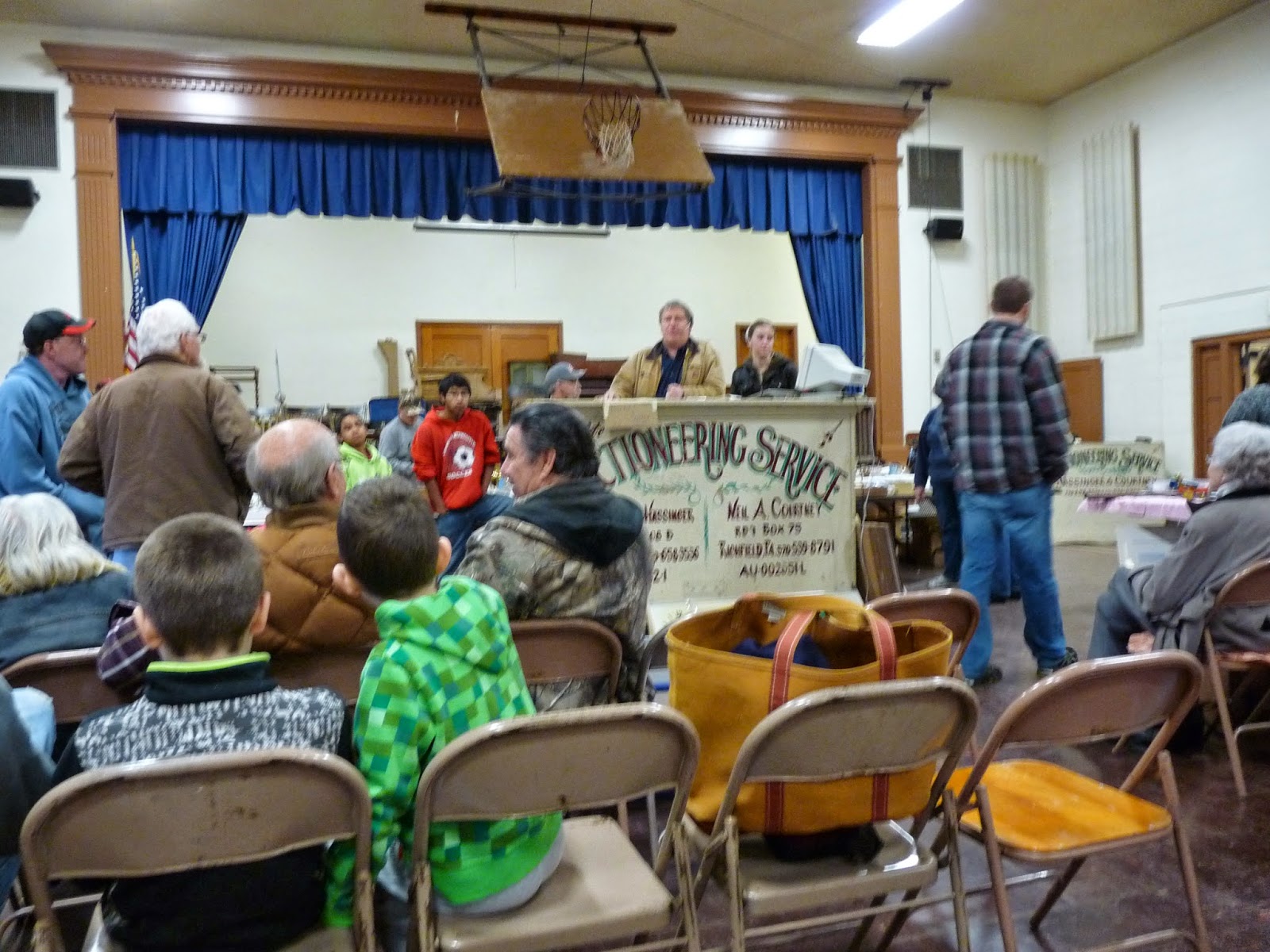
In June 2013, my mother-in-law passed away at the age of 100, leaving two houses uninhabited. She and my father-in-law, when he was living, spent the summers in the country and winters in town. Something needed to be done with the contents of both houses and the outbuildings. My husband contacted an auctioneer about having a sale. He recommended waiting until March of 2014. He said spring is the peak of the auction season when everyone is ready to get out of their houses and before the outdoor work begins.

Her favorite doll, almost 100 years old

To get ready, we had to pack everything since the auction would be at another location. I wrapped many, many dishes. My mother-in-law lived in the same house as her mother and grandmother before her with each keeping the dishes of the one before. I also readied her doll collection, her paperweight collection, her books, her bedding, and sorted through most of the papers in the house. My husband did the garages, the attic, the upstairs, and stacked every box that was packed.


The two of us totaled at least 150 hours on the project.  At first, it was fun discovering family photos, memorabilia, more dolls, and additional paperweights I had never seen. The last week got very tiring. 

Her paper weight collection
The living room after packing


We loaded up from six different buildings. 
Fortunately, we had our immediate and extended family helping us. 
The auctioneers’ workers getting things ready

          Unloading at the auction site

The sale went well. The auctioneers said that it was as good as it gets in this present age of Internet buying. 

                Whew! 
                                                   
      We are glad that is over!
The most popular item